



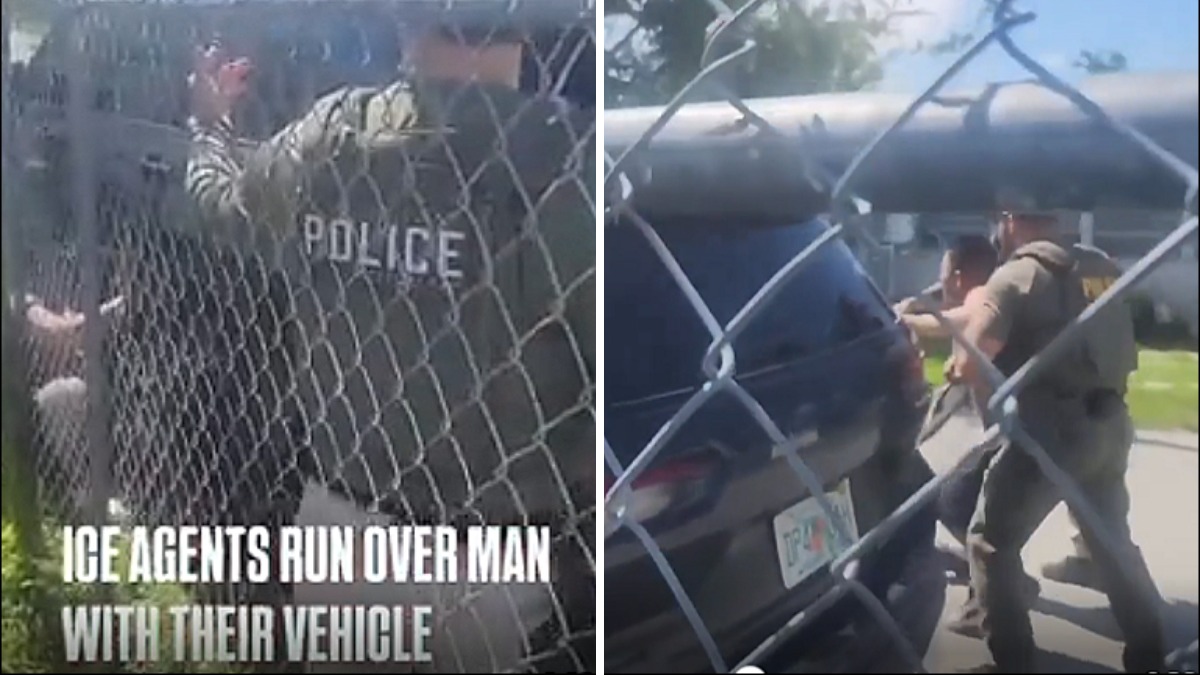

A troubling scene unfolded in Hallandale, Florida, recently when bystanders captured footage of ICE agents allegedly striking a man with their vehicle before the agents appeared to force him into an SUV as he screamed. ICE has not publicly responded to the allegations shown in the video. As reported by The Nerd Stash, the video, which surfaced on Reddit, shows the man on the ground near the vehicle while the SUV nudges forward.
You can hear the person recording the incident shouting at the agents, and his tone in the video sounds like disbelief. The bystander yelled, “Yo, what y’all doing bro?! Y’all can’t do that!” The footage shows one agent gesturing toward the driver while another moves to assist in detaining the man. By the time they manage to get him on his feet, he is visibly limping.
The person behind the camera continued to confront the officers, telling them he had the entire event recorded, including footage from security cameras situated around his home. In my opinion, despite the vocal protest and what appeared to be distress from the individual being detained, the agents proceeded with the arrest without hesitation. A similar confrontation played out when a man recording a Texas ICE detention alleged an agent shoved him, asking “Why’d you hit me, bro?” on camera.
What the law actually allows victims to do
This incident has ignited a firestorm of discussion regarding the limits of federal authority and the lack of public accountability for such actions. I believe many people online are viewing this not as a one-off event, but as a broader indicator of the unchecked power that the agency maintains today. For decades, the path to holding federal officials accountable for constitutional violations was clearer.
In 1971, the Supreme Court established in Bivens v. Six Unknown Named Agents that federal officials could be sued directly for excessive force. However, the legal landscape shifted significantly in 2022 with the case Egbert v. Boule. In a 6-3 ruling, the Supreme Court determined that Bivens claims do not extend to Fourth Amendment excessive force claims or First Amendment retaliation claims against federal agents, including those in immigration enforcement.
This ruling has effectively closed off the Bivens path as a practical route for victims seeking justice against ICE agents specifically. It leaves the Federal Tort Claims Act as the primary remaining avenue for those who believe they have been wronged. Under the Federal Tort Claims Act, lawsuits can be filed against the United States itself for state-law torts, such as assault and battery committed by federal officers. However, this process comes with a very strict timeline.
You must file an FTCA claim with the Department of Homeland Security within two years of the incident.





Published: Aug 14, 2026 06:15 pm