



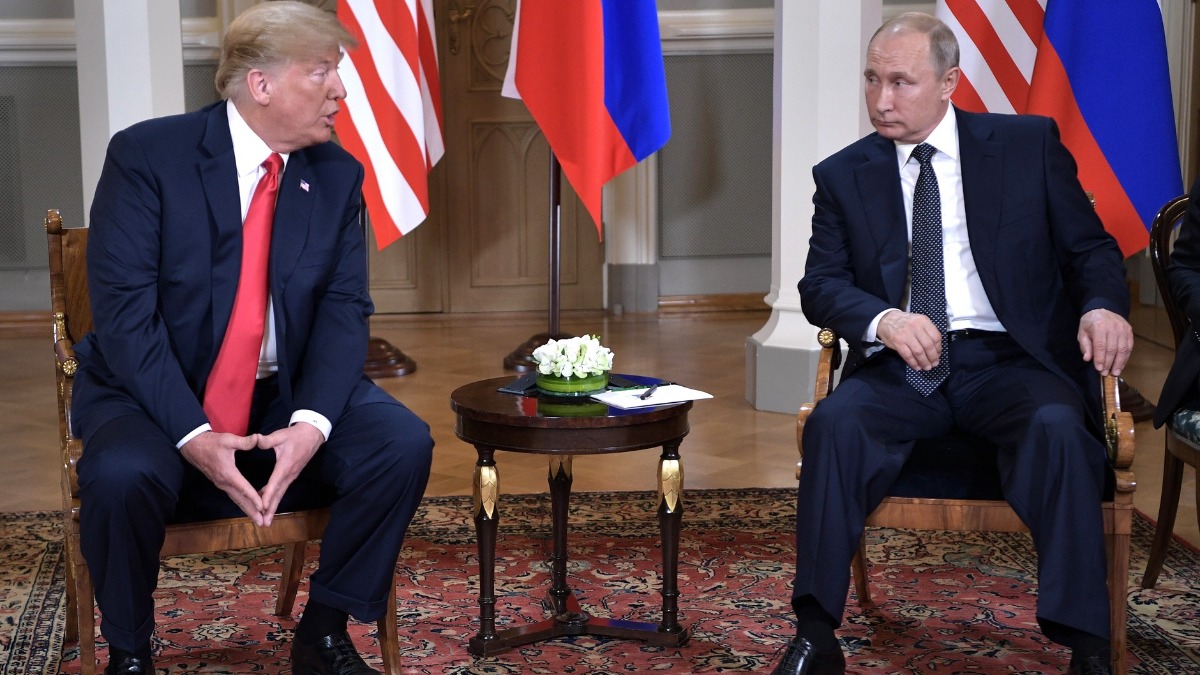

President Trump recently signaled that he is prioritizing an end to the conflict in Ukraine over a potential diplomatic assist from Russia regarding Iran’s nuclear program. While hosting the astronauts of the Artemis II mission in the Oval Office, the President revealed that he engaged in a phone call with Russian President Vladimir Putin, The Hill reported. During this conversation, the two leaders touched upon the ongoing war in Ukraine and the United States military campaign against Iran.
It appears that Putin offered to assist the United States by dealing with Iran’s enriched uranium stockpile. Specifically, the Russian leader proposed taking about 1,000 pounds of enriched uranium out of Iran, which is the fuel necessary for developing a nuclear weapon. This aligns with recent discussions between Russia and Rafael Grossi, the head of the International Atomic Energy Agency, regarding the possibility of removing that highly enriched material from Iranian soil.
However, President Trump made it clear that he isn’t ready to take the Russian leader up on this offer just yet. “We talked more about the war in Ukraine, but he’d like to be of help [with Iran] — I said before you help, we want to end your war,” Trump remarked. He emphasized that he views the U.S. conflict with Iran and Russia’s invasion of Ukraine as being on similar timelines toward a resolution. In the same conversation, Trump noted that he asked Putin for a “little bit of a ceasefire” in Ukraine.
While the diplomatic maneuvering continues, the status of Iran’s nuclear material remains a top concern for international monitors
The situation on the ground remains complex. Yury Ushakov, an aide to Putin, reportedly told the Russian news agency TASS that the Russian side proposed a ceasefire to coincide with the Victory Day celebrations, which is the May 9 holiday commemorating the 1945 Soviet victory over Nazi Germany.
This follows a previous attempt at a 32-hour ceasefire in April during the Orthodox Easter holiday, which ultimately failed after both Moscow and Kyiv accused each other of violating the terms. An official from the office of the president of Ukraine indicated that they need further clarification on the details of these discussions before providing an official response.
According to Rafael Grossi, the IAEA believes a large percentage of Iran’s highly enriched uranium is currently stored in tunnels at the Isfahan nuclear complex. This site was the target of airstrikes last year and has faced additional, less intense attacks during the recent U.S.-Israeli war. Satellite images from an Airbus satellite, dated June 9, 2025, show a truck loading 18 blue containers into a tunnel at the Isfahan center, which the agency believes contain the uranium.
Grossi stated that the agency has not been able to inspect these sites since Israel launched a 12-day war last June. Consequently, inspectors cannot confirm that the material is still there or that the IAEA seals remain intact. The agency estimates that Iran possesses roughly 440.9 kilograms, or 972 pounds, of uranium enriched up to 60 percent purity. This is a technical step away from the 90 percent purity required for weapons-grade material. Grossi has previously warned that this stockpile could potentially allow Iran to build as many as 10 nuclear bombs if they chose to weaponize their program.
Tehran continues to maintain that its nuclear program is peaceful, though the U.S. remains skeptical. President Trump has stated that a primary reason for the U.S. going to war was to prevent Iran from developing nuclear weapons, even as he has insisted that the strikes last summer “obliterated” the country’s atomic capabilities. Grossi noted that the current situation is a “completely different ballgame” compared to the 2015 agreement, citing Iran’s “exponential progress” in using newer generations of centrifuges and developing new facilities.
Beyond the nuclear file, tensions remain high in the Strait of Hormuz. The U.S. is currently maintaining a blockade that prevents Iranian oil tankers and commercial vessels from exiting the strait. In retaliation, Iran has threatened to attack ships that do not coordinate with its military. President Trump remains firm on his stance regarding this chokehold. “They have to cry uncle, that’s all they have to do,” Trump said. “Just say, ‘We give up. We give up.’ But their economy is really in trouble.”
The economic pressure from rising gas prices is also mounting, creating a difficult environment for the administration during this midterm election year. With GOP majorities in the House and Senate on the line, the resolution of these conflicts has become increasingly urgent.
While Grossi maintains that he is a negotiator who likes to see a “flicker of hope” for a deal, he admits that it will take significant “political will” from Tehran to move forward. For now, the administration is rejecting Iran’s latest proposal, which sought to postpone nuclear discussions in exchange for the U.S. lifting the blockade on the Strait of Hormuz.







Published: Apr 30, 2026 04:15 pm