



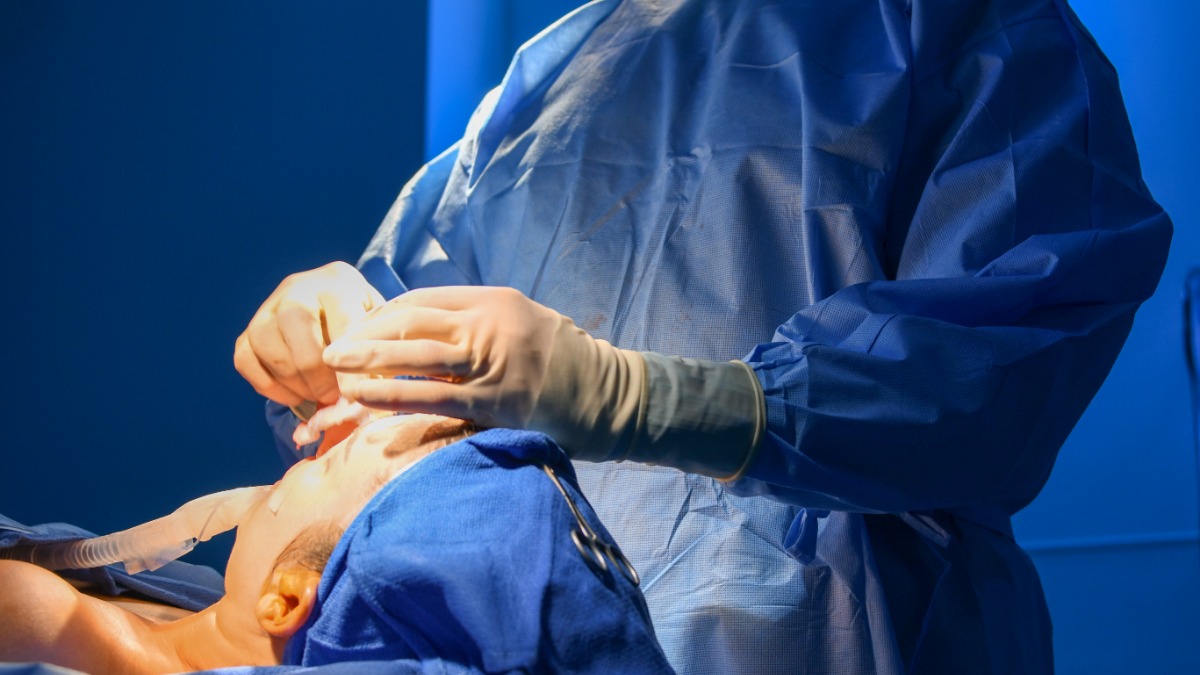

Surgeons have pulled off a reconstruction that looks almost impossible at first glance. Instead of rebuilding a damaged nose directly on a patient’s face, they temporarily grew a new one on his forehead before preparing it for transplant.
The extraordinary procedure was carried out after a worker from Iraq lost about 99% of his nose in a high-voltage electrical accident. Rather than using a conventional reconstruction, doctors chose one of the rarest techniques in modern plastic surgery.
According to Dexerto, the operation has drawn global attention because of how uncommon the procedure is. The case was led by Iraqi plastic surgeon Dr. Diyar Abdulwahid, who later explained each stage of the remarkable reconstruction.
You’d never guess why the new nose ended up on his forehead
The multi-stage operation was led by Dr. Diyar Abdulwahid, a specialist in aesthetic and plastic surgery. He discussed the rare procedure during an appearance on Channel8’s Health News bulletin.
The reconstruction used a prelaminated paramedian forehead flap, which is considered one of the most advanced techniques for rebuilding severe nasal defects. Doctors first created the framework of the patient’s future nose using cartilage.
Doctors then placed that framework beneath the skin of his forehead, where there is a strong and reliable blood supply. Over the following weeks, the surrounding tissue naturally developed around the cartilage while staying connected to its original blood supply.
The reconstruction also highlights how rapidly medical technology continues to evolve across different specialties. In another breakthrough, humanoid robots successfully assisted in a historic surgical procedure, marking a major step toward their future role in operating rooms.
Once the tissue became stable and healthy, surgeons prepared for the next stage. They detached the newly formed nose from the forehead and transferred it to its proper anatomical position on the patient’s face.
Dr. Abdulwahid also shared the case on Instagram. He wrote, “A prelaminated paramedian forehead flap for nasal reconstruction.” He explained that the surgery was performed on a worker who lost most of his nose because of a high-voltage electrical injury.
He further revealed that the next stage would involve moving the reconstructed nose to its normal position. Dr. Abdulwahid also described the operation as “exceptionally rare in global medical literature.”
Advances in medicine are also extending beyond surgery into experimental biotechnology. Recently, entrepreneur Bryan Johnson drew attention after claiming he had created a “newborn clone” of himself as part of his latest longevity experiment.
The unusual reconstruction highlights how advanced reconstructive surgery has become. Although the technique is rarely performed, it offers hope for patients who suffer devastating facial injuries when conventional reconstruction is no longer possible.








Published: Aug 4, 2026 06:15 pm