



I’ve spent years tinkering with brewing stands in my survival worlds, and if there is one thing I’ve learned, it is that the Potion of Weakness is the most underrated tool in your alchemical arsenal. Whether you are trying to slash the damage of a Ravager during a raid or you are looking to exploit the massive economic benefits of villager curing, this potion is your ticket to high-level play.
In the current 1.21.11 patch, the meta has shifted significantly, especially with how we handle trading halls and the new threats lurking in Trial Chambers. Most people think brewing is a late-game headache, but the Potion of Weakness is actually a rebel. It is the only primary potion that does not require Nether Wart. You can basically walk up to a brewing stand with some water and a fermented eye and get to work. Here is my personal breakdown on how to master this brew and why you need it for your next session.
Gathering the Alchemical Reagents
Before I even touch the brewing stand, I make sure my inventory is stocked. You are going to need a few specific items, and I always recommend using a sword with Looting III to maximize your efficiency.
- Blaze Powder: This is your fuel. One piece of powder actually lasts for 20 brewing cycles, so you don’t need a mountain of it. You get this by crafting Blaze Rods found in Nether Fortresses.
- Fermented Spider Eye: This is the core of the recipe. You make it by combining a regular Spider Eye, Sugar, and a Brown Mushroom in your 3×3 crafting grid.
- Water Bottles: Just craft some Glass Bottles (three glass blocks in a V-shape) and right-click any water source. I usually keep an infinite water source right next to my brewing station to save time.
- Gunpowder: If you want to cure villagers, you must have this. It turns your drinkable potion into a Splash Potion, which is the only way to apply the effect to a zombie.
- Redstone Dust: I always keep a stack of this handy to extend my potion duration from 1:30 to 4:00.
If you are just starting a new world and need a good head start on finding these resources, you should check out our guide on how to make Potion of Weakness.
Brewing Step by Step in the 1.21 Interface
I’ve seen plenty of players get confused by the UI, but it is actually quite simple once you know the navigation. Follow these steps exactly as I do:
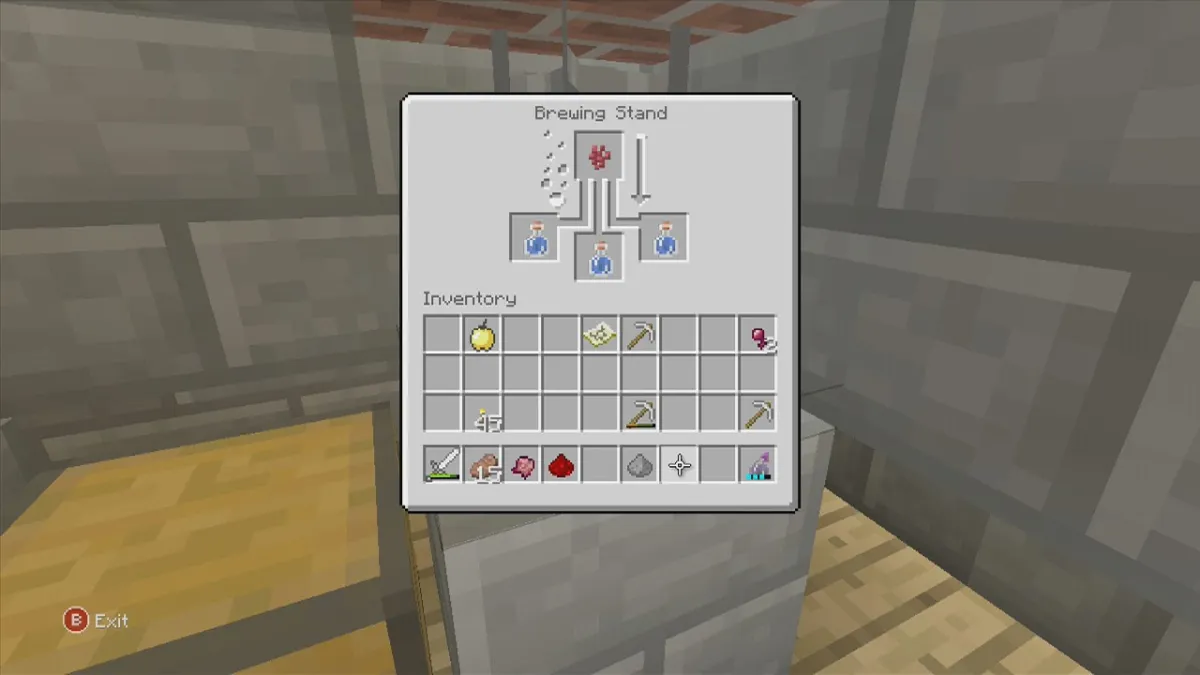
- Open your Brewing Stand by right-clicking it.
- Drag your Blaze Powder into the far-left fuel slot. You’ll see the orange bar fill up, indicating you have 20 charges.
- Place your three Water Bottles into the bottom three slots. Pro tip: Always brew three at once; it costs the same amount of ingredients as brewing one.
- Drop your Fermented Spider Eye into the top ingredient slot. You will see the arrow start to fill up, which takes exactly 20 seconds.
- Once that is done, you have a standard Potion of Weakness. To make it a splash version, remove the eye and put Gunpowder in that same top slot.
- If you want the effect to last longer, put Redstone Dust in before the Gunpowder.
While you are waiting for your potions to finish, you might want to spruce up your brewing room. I usually use smooth stone for a clean, laboratory look. If you don’t know how to make it, my Smooth Stone guide covers everything from early-game crafting to full automation.
The Mathematical Reality of Weakness
I often hear players ask if the potion is worth it in combat. The answer depends entirely on which version of the game you are playing, as the mathematical models for damage reduction are completely different.
In Java Edition, Weakness I is a flat subtraction model. It reduces the total melee damage of the affected entity by exactly 4 points, or two full hearts. This happens after the weapon damage and Strength bonuses are calculated.
However, if you are playing on Bedrock Edition, the game uses an exponential decay model that is much more punishing for low-damage mobs but less effective against heavy hitters. The melee damage under the Weakness effect is calculated using this formula: Damage = BaseDamage * 0.8^level + (0.8^level – 1) / 0.4
For Weakness I, this results in a reduction of 20% of the base damage plus an additional 0.5 points. If you are fighting a mob that deals very low damage, this can actually nullify the attack entirely. But in Bedrock, enchantments like Sharpness can sometimes bypass this floor to ensure some damage is still dealt.
Maximizing Your ROI with Villager Curing
The real reason I brew these potions is for the “Zombie Doctor” advancement and the subsequent economic boom. However, you need to be aware of the 1.20.2 update, which fundamentally changed how curing works.
In the old days, we could stack discounts five times to get everything for one emerald. Now, Mojang has capped the permanent discount to the first cure only. Here is how the ROI (Return on Investment) breaks down for a single Golden Apple and one Splash Potion of Weakness:
- Treasure Items: For things like Mending books or Bells, the “major_positive” gossip tag gives you a permanent -20 emerald discount. If the book originally cost 30 emeralds, it will now cost 10.
- Bulk Resources: For fletchers (sticks) or farmers (pumpkins), the discount is usually -5 units. A 32-stick trade will drop to 27 or 26.
- Stacking Potential: While you can’t stack curing discounts anymore, you can stack a cure with the Hero of the Village effect. Combining a single cure with a level V raid victory can still push high-end trades down to the 1-emerald floor.
To speed up the curing process, which normally takes 3 to 5 minutes, I always place Iron Bars and a Bed within a 4-block radius of the zombie villager. This has a high probability of accelerating the transformation timer.
Farming Ingredients and Spatial Optimization
If you are running a massive trading hall like I do, you need a constant supply of mushrooms and Blaze powder. You can’t just rely on finding them in caves.
For Brown Mushrooms, I build 2-block-high dark rooms. The technical spread mechanic is quite specific: a mushroom has a 4% chance to spread per random tick, but only if there are fewer than 5 mushrooms of its type in a 9x9x3 area. To maximize my yield, I layout my “seed” mushrooms in a grid, spacing them 3 blocks apart to allow for maximum lateral growth without hitting the density cap.
For Blazes, I optimize around the spawner’s 9x3x9 spawning volume. Blazes require a light level of 11 or lower. To “toggle” my farm, I use four dispensers with lava buckets on the ceiling. When the lava flows, it raises the light level to 12 or higher across the entire spawning volume, effectively disabling the spawner so I can safely enter the chamber for maintenance.
Weakness Utility in 1.21 Trial Chambers
The 1.21 update introduced Trial Chambers, and I’ve found that a Splash Potion of Weakness is a lifesaver when navigating the Atrium or the combat-heavy Chambers.
When you trigger an Ominous Trial Spawner, you often get swarmed by Bogged (the new poison skeletons) or standard Zombies. While the Breeze mob is mostly a projectile threat that you need to melee down, the “chaff” mobs around it can wear you down. Throwing a Weakness potion at a group of Bogged reduces their melee threat while you focus on deflecting wind charges.
I’ve also noticed that in these structures, finding copper and tuff walls is your best navigation landmark. If you are lost in a deepslate cave at Y-30 and see chiseled tuff, you are right on the edge of a chamber. Having a few 4-minute Weakness potions in your Shulker Box is my standard “pro-play” setup for raiding these dungeons.








Published: Apr 21, 2026 05:39 pm