


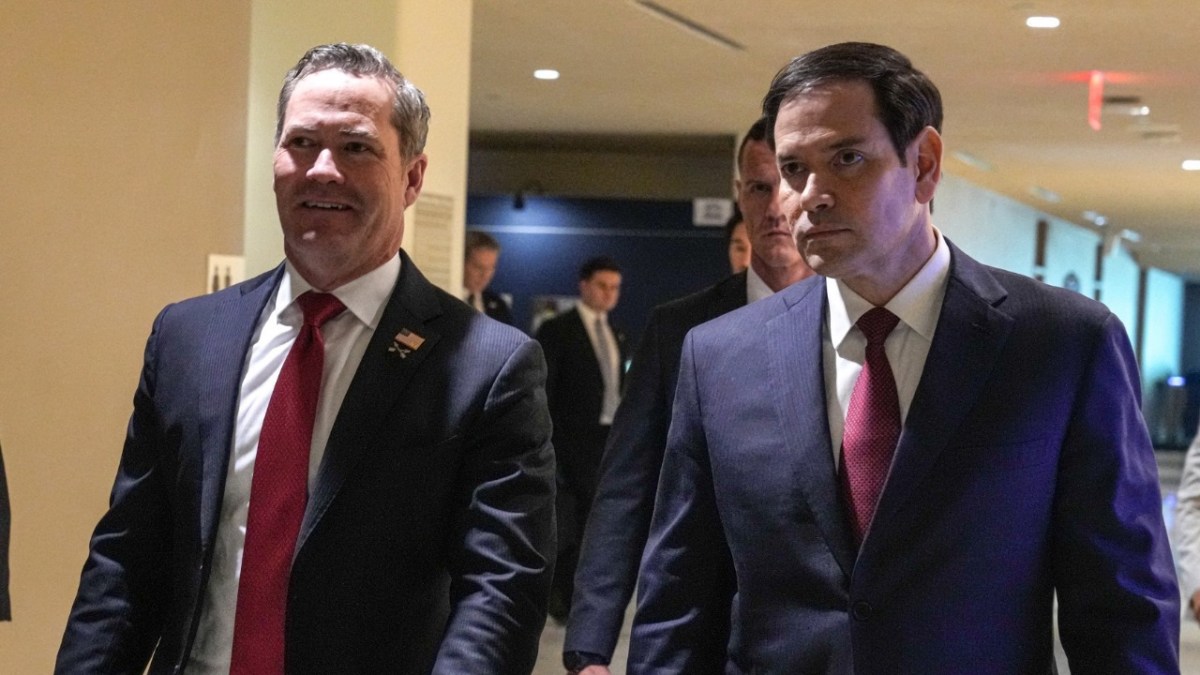

U.S. Ambassador to the United Nations Mike Waltz and Cuban Foreign Minister Bruno Rodríguez Parrilla engaged in a shouting match on the floor of the United Nations General Assembly on Tuesday, October 27. The confrontation occurred during an annual debate regarding the long-standing United States economic embargo against Cuba.
According to ABC News, the tension flared after Waltz took the podium to deliver a speech very critical of the Cuban government. As Waltz spoke, the Cuban delegation began pounding on tables and shouting objections. PEOPLE reported that the incident reached a boiling point as Rodríguez approached the front of the hall, which led Assembly President Khalilur Rahman to suspend the meeting temporarily when his calls for order weren’t heeded.
Per the outlet, Waltz, a former Green Beret, began shouting when the Cuban foreign minister moved toward him. “Mr. President, this individual needs to back away from this podium. He’s not going to intimidate me in the United States of America! I’m the representative of the United States of America! Back up!” he said.
Both delegates had barbs to throw at each other
The U.S. ambassador also contrasted the atmosphere of the United Nations with the political climate in Havana. ABC reported that he told the assembly, “I know you don’t like to hear this. This is America, my friend. This is the United Nations. This isn’t your communist dictatorship. You cannot silence me and you cannot silence my colleagues.”
Rodríguez reportedly labeled Waltz a “liar” during the heated moment. After the assembly president allowed him to speak on a point of order, the foreign minister accused the ambassador of “grossly lying.” Per ABC, Rodríguez later said that Waltz “with his arrogance and hubris, forgets that he is at the United Nations, not at the US National Security Council, nor in a Green Berets unit, nor in a Signal group, where he has repeatedly shown his incompetence and incapacity.”
PEOPLE noted that this diplomatic clash follows months of increasing friction between the two nations. President Donald Trump signed an executive order in January 2026 that placed tariffs on countries supplying oil to Cuba, which significantly restricted fuel shipments to the island.
Amid those fuel shortages, Cuba suffered a blackout across most of the island in March 2026 after a major power plant failed. Havana has long blamed the U.S. embargo for its economic and energy troubles, while Washington attributes them to Cuba’s state-run economy.
Trump has also made public comments regarding his stance on the island, telling reporters in March that he believes he will have “the honor of taking Cuba.” He further said, “Whether I free it, take it. I think I could do anything I want with it, you want to know the truth?”
The General Assembly voted the following day to condemn the embargo for the 34th consecutive year, 130 to 17 with 25 abstentions, as reported by the Associated Press. That marked a notable drop from last year’s 165-7 result, which the AP attributed to a U.S. campaign to persuade member states to vote against the measure or abstain.






Published: Oct 28, 2026 07:45 pm