



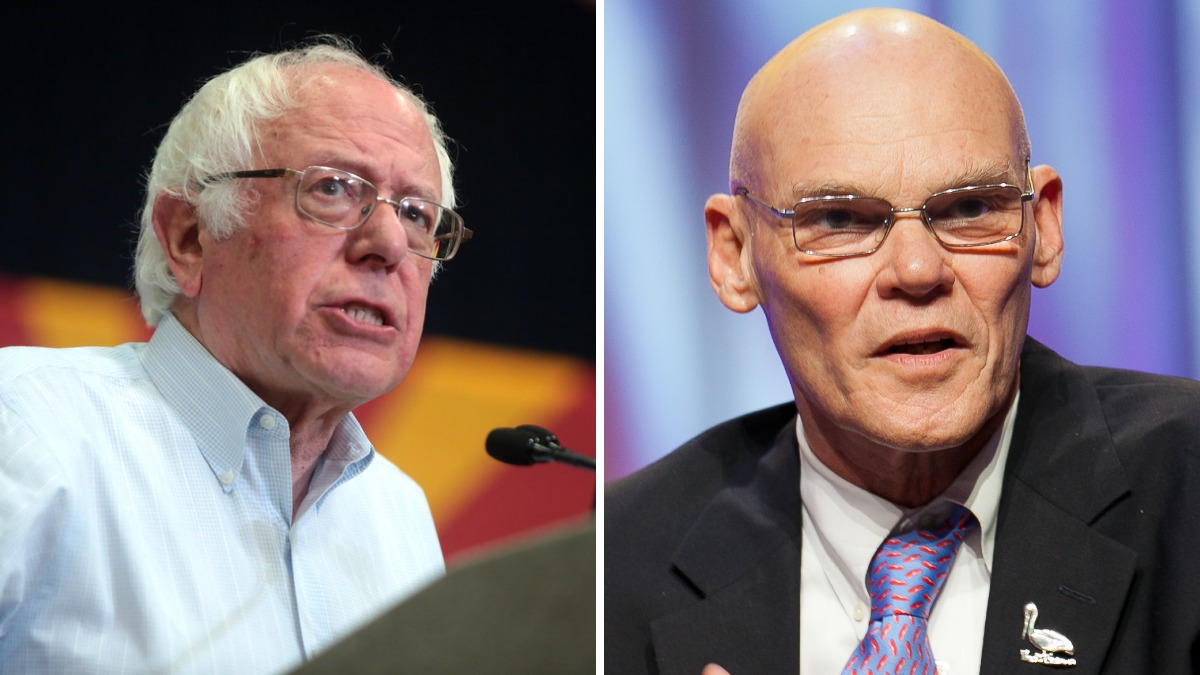

Senator Bernie Sanders has officially told Democratic strategist James Carville to start his own party. This reaction comes after Carville spent the weekend expressing deep frustration over the growing influence of left-wing candidates and figures within the Democratic ranks.
The tension started when Carville made it clear he would consider leaving the Democratic Party if popular Twitch streamer Hasan Piker becomes a fixture in the organization. Piker has been actively campaigning alongside various progressive candidates during the midterm primary season.
Sanders addressed these comments during an interview on Tuesday, as reported by The Hill, making it obvious he disagrees with the strategist’s stance. Sanders said, “Well, that’s not much of a choice. If Mr. Carville doesn’t want to be in my party, the party I belong to, that Piker, that El-Sayed belongs to, he can start his own party.”
The senator also brought up the influence of corporate interests on the party
Sanders was referencing Abdul El-Sayed, the Michigan Senate candidate who secured a win over Representative Haley Stevens in the Democratic primary held on Tuesday. For Sanders, who identifies as a democratic socialist and has caucused with Democrats for years, the party needs to be a big tent. He emphasized that people like Piker should be welcomed into the fold, rather than pushed away by established figures.
Carville is no stranger to the political spotlight, having risen to fame for his work on the 1992 campaign for Bill Clinton. Lately, he has been vocal about his concerns regarding the rise of democratic socialist candidates who have managed to defeat longtime incumbents.
Carville told Donie O’Sullivan on Sunday that these candidates are “too hotheaded to know that they’re not popular.” He further argued that these individuals could lead the party toward losing races that should have been safe, especially if primary turnouts are skewed. Carville also brought up Sanders’s own past presidential runs, specifically his losses in 2016 and 2020, to highlight his skepticism regarding the electability of the progressive wing.
Piker had a sharp response to those claims of electability, suggesting that the party’s more traditional path hasn’t exactly been a winning strategy either. He pointed toward the losses of Hillary Clinton in 2016 and Kamala Harris in 2024 to President Trump as examples of how previous neoliberal Democratic candidacies have fared.
Sanders took the argument a step further by questioning what kind of party voters actually want to support. He pointed to the party leadership’s financial ties to the American Israel Public Affairs Committee. Sanders noted that this support backs an extremist government led by Benjamin Netanyahu, which human rights groups and international bodies have accused of committing war crimes and genocide in the Gaza Strip. Netanyahu has rejected those claims, but the internal debate remains heated.
“Do you really want to be in a party where your leadership is taking huge amounts of money from AIPAC, which is supporting an extremist Netanyahu government that many of us believe have committed a genocide?” Sanders said. “You want to be in a party with people who do that?”
The senator also brought up the influence of corporate interests on the party. He specifically questioned whether voters want to be in a party that has failed to stand up to the AI industry. Sanders suggested that these policy stances are tied to significant campaign contributions from the AI and crypto sectors, leaving voters to decide which issues matter most to them as they look toward the future of the party.









Published: Aug 5, 2026 04:30 pm