



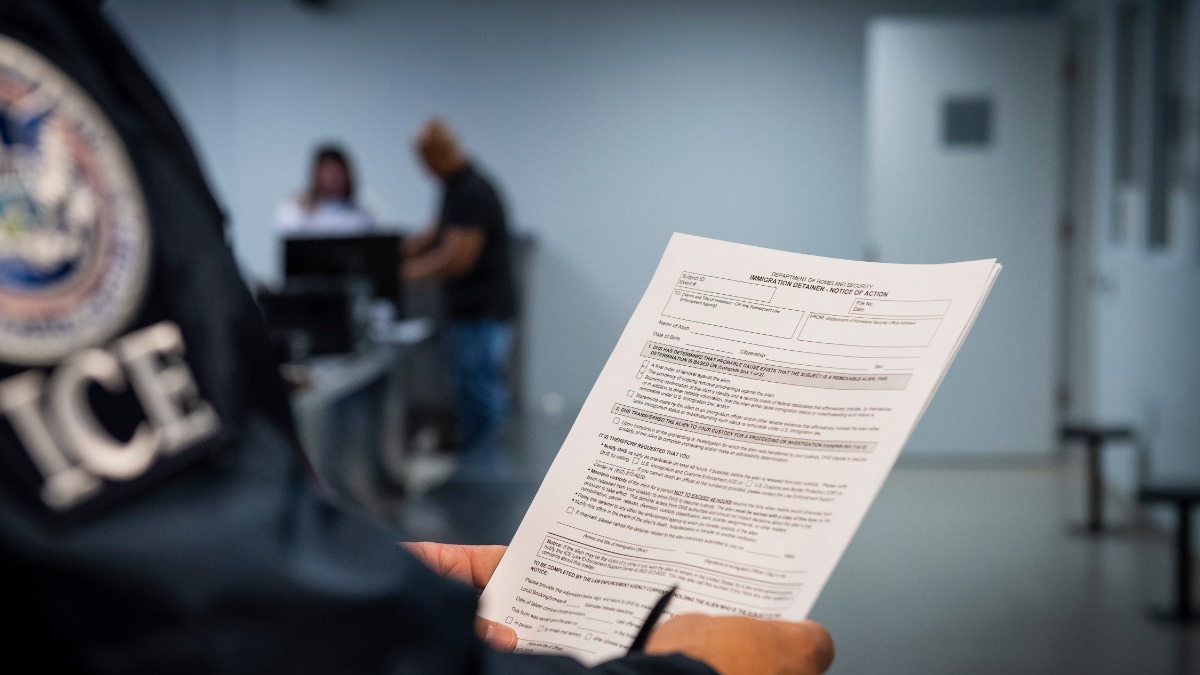

U.S. Immigration and Customs Enforcement is ending a policy that required the agency to report the deaths of former detainees that occurred within 30 days of their release from federal custody, ABC News reported. This shift comes as the agency faces intense scrutiny from immigrant advocates and lawmakers over a sharp increase in the death rate of migrants currently held in federal detention facilities.
Under the previous guidelines, which were established during the Biden administration, the agency was required to review and report all fatalities involving detainees, even those that took place shortly after an individual was released from custody. The Department of Homeland Security has defended the move as a return to standard procedure.
A spokesperson for the department told ABC News that, “Under this updated policy, when an individual is no longer in ICE custody, then ICE will no longer be responsible for monitoring or reviewing deaths that may occur,” adding that, “This is common sense. ICE is not responsible when an individual passes away weeks after leaving their custody.” Despite this change, the spokesperson noted on Thursday that ICE “remains committed to transparency regarding detainee deaths.”
This raises questions about accountability in the US immigration system
The timing of this policy reversal is notable, as data shows the first 14 months of the second Trump administration represent the most deadly period for the federal detention system in recent years, excluding 2020 when the coronavirus pandemic impacted mortality rates. As of March 29, 45 people have died in government custody during the current administration. This figure includes two victims of a shooting at a Dallas detention facility last September. The total number of deaths in ICE custody since the start of the second Trump administration has reached 49, according to figures shared by lawmakers.
The mortality rate within these facilities has seen a rapid acceleration. While the rate was one death per 100,000 admissions in 2022, it surged to seven deaths per 100,000 admissions in 2025. In just the first ten weeks of 2026, the rate has climbed even higher to 11 deaths per 100,000 admissions.
Aaron Reichlin-Melnick, an immigration policy expert with the American Immigration Council, noted the severity of the trend, stating, “There is really no contest — fiscal year 2026 is on track to be the deadliest year ever in the history of ICE.” He added, “Things are dramatically worse this year. We are seeing more deaths than ever.”
This surge in fatalities is happening as the detention population reaches record highs, recently exceeding 70,000 people. The administration has pushed to expand detention capacity by converting warehouses and other spaces into facilities, with documents shared with New Hampshire Gov. Kelly Ayotte indicating the government expects to spend $38 billion on these expansions to add over 92,000 beds.
Unlike previous administrations that utilized “Alternatives for Detention” programs like ankle monitors and regular check-ins, the current administration has doubled down on mandatory detention, including for those who are in the process of seeking legal status and families with children.
The human toll of these conditions has been highlighted by the case of Emmanuel Damas, a Haitian immigrant who died in March. His brother, Presner Nelson, recently visited a shopping mall to purchase a suit for his brother to wear in his casket. Nelson disputes the government’s characterization of his brother as a “criminal illegal alien,” stating that Damas was in the country legally with a pending petition for Temporary Protected Status. According to Nelson, his brother had been complaining of a severe toothache for two weeks while in custody but was denied requests to see a dentist.
ICE stated that Damas was taken to a hospital on February 19 after reporting shortness of breath and was transferred to an Intensive Care Unit in Phoenix for a higher level of care. By February 22, the hospital reported the likely diagnosis as septic shock due to pneumonia. Damas was pronounced deceased at 1:12 PM on March 2.
A DHS spokesperson claimed Damas had refused dental extractions on multiple occasions in January and February, stating that, “It is a longstanding practice to provide comprehensive medical care from the moment an individual enters ICE custody. This includes medical, dental, and mental health services, access to medical appointments, and 24-hour emergency care.” However, Nelson remains convinced that his brother’s death was a result of “gross negligence,” asserting that, “They waited for too long to take him to the hospital to be seen by a dentist.”
Concerns have also been raised regarding a number of “presumed suicides” in detention, including the deaths of 19-year-old Royer Perez-Jimenez in Florida and Victor Manuel Diaz in Texas. While the government has labeled these incidents as presumed suicides, families are often left without clear answers.
This lack of clarity is further complicated by cases like that of 55-year-old Geraldo Lunas Campos, who died at the Camp East Montana facility in January. Although DHS initially reported the death as a result of medical distress, an autopsy by the El Paso County Medical Examiner later ruled the death a homicide, citing “asphyxia due to neck and torso compression.”
As detention numbers continue to rise, the administration’s decision to stop reporting post-release deaths marks a significant shift in how the government handles oversight and accountability within the immigration system.









Published: Jun 5, 2026 03:45 pm