



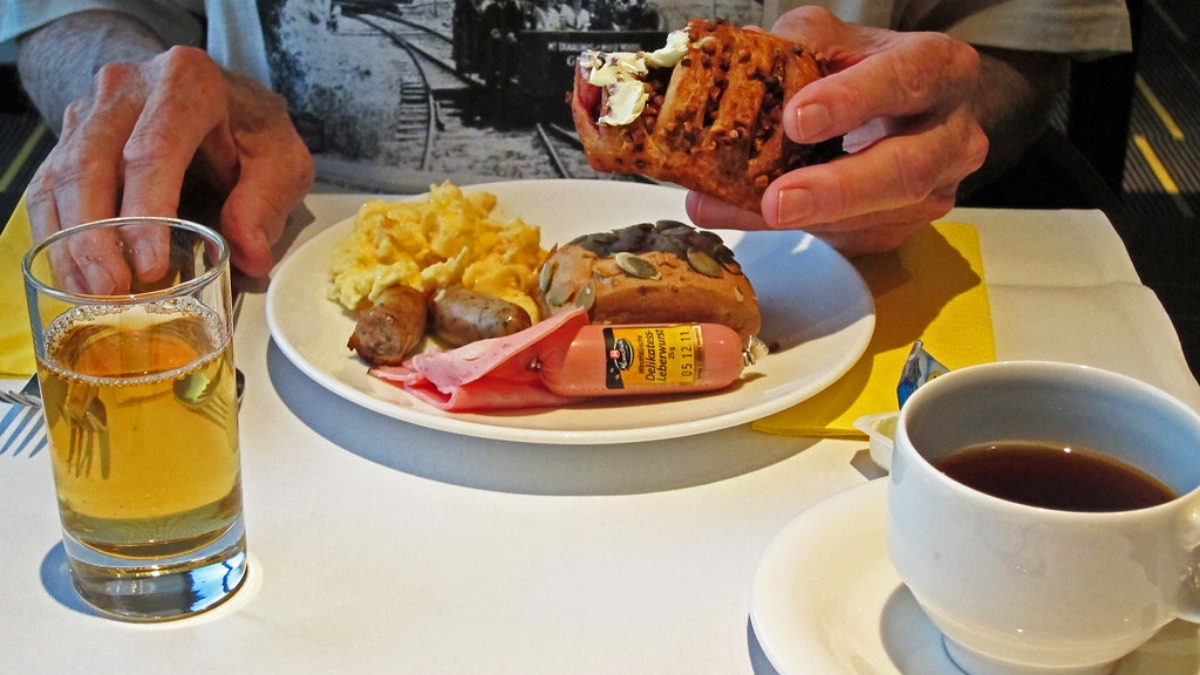

The next time you find yourself standing in front of a hotel breakfast buffet, you might want to think twice before reaching for those scrambled eggs. A viral video posted by a hotel employee has pulled back the curtain on how those mass-produced breakfast items are actually prepared, and over 10 million viewers are now having second thoughts about their morning meal.
The video, which was first highlighted by Daily Dot, features TikToker Liz standing in a hotel kitchen and preparing to cook a large batch of eggs. In the clip, she places a massive plastic bag filled with a liquid egg mixture directly into a microwave and reheats the entire package without ever removing the contents. Once the timer goes off, she pulls out the heated plastic bag to reveal a cooked, solid brick of egg, then chops it up until it resembles the scrambled eggs sitting in those warming trays.
The text displayed on screen is blunt: “Make hotel scrambled eggs with me!! (You might never want them again).” It is a sentiment that clearly resonated with the public. While many viewers were quick to ask why hotel staff don’t just crack dozens of eggs by hand, the reality of the hospitality industry is more focused on efficiency.
Mass-produced eggs are the industry standard, but the method raises real health questions
Buffets and fast-food chains routinely rely on premixed egg products to save time and money. According to discussions on the r/Ask subreddit, this is standard operating procedure for many kitchens. One person laid out the math: using a tilt skillet with oil, a worker can scramble enough eggs for 250 people in just 45 minutes from a single case of pre-mixed, homogenized eggs, the equivalent of 40 dozen.
When compared to cracking eggs individually, the industrial approach makes obvious business sense. Pre-mixed eggs reportedly cost around 19 cents per ounce, making them a cost-effective choice for hotels. Amid similar scrutiny over what consumers are actually getting from food brands, a Trader Joe’s caffeine mislabeling suit filed in California in April alleged customers were misled about what they were buying.
The convenience of the hotel egg process, however, has sparked a heated debate over health. Many viewers were immediately concerned about the safety of cooking food inside a plastic bag. “Secret ingredient: Microplastics,” one user commented. Another wrote: “This is actually exactly how I imagined them being made, therefore the reason I’ve never touched them.”
Those concerns have research behind them. The American Osteopathic Association warns that heating plastic in a microwave can cause particles to seep into food. A 2023 study published in Environmental Science and Technology found that just three minutes of microwave heating can release up to 4.22 million microplastic particles and 2.11 billion nanoplastic particles from a single square centimeter of plastic.
The heating process causes plastic to release chemicals and tiny fragments into the food. These plastics often contain additives called plasticizers, such as phthalates, which are used to make the material flexible and durable. Because these additives are not chemically bonded to the plastic, they can migrate into food when exposed to heat. Phthalates are classified as endocrine disruptors that can interfere with the hormone system by mimicking or blocking natural hormones, potentially affecting fertility and development.
While some products are labeled microwave safe, that designation only means the plastic won’t melt or warp, it does not mean chemical or particle migration is zero. The 2023 study found that even polypropylene containers, marked with a #5 and widely considered the standard for microwave-safe materials, still released billions of nanoplastics during heating. Consumer frustration with chain food quality has been particularly visible lately, including Whataburger quality complaints that went viral after a Texas customer documented what she received after an eight-minute drive-thru wait.
Despite the potential risks, not everyone is ready to give up their hotel breakfast. “I’m still gonna eat that. Nothing a little salt and pepper can’t fix,” one viewer wrote. Another added, “Lil pepper and hot sauce and some of that nasty cheap bread toasted and I’m all set babe.” For some travelers, the appeal of a free breakfast is too strong to ignore, even after seeing what goes into making it.






Published: Apr 30, 2026 05:30 am