


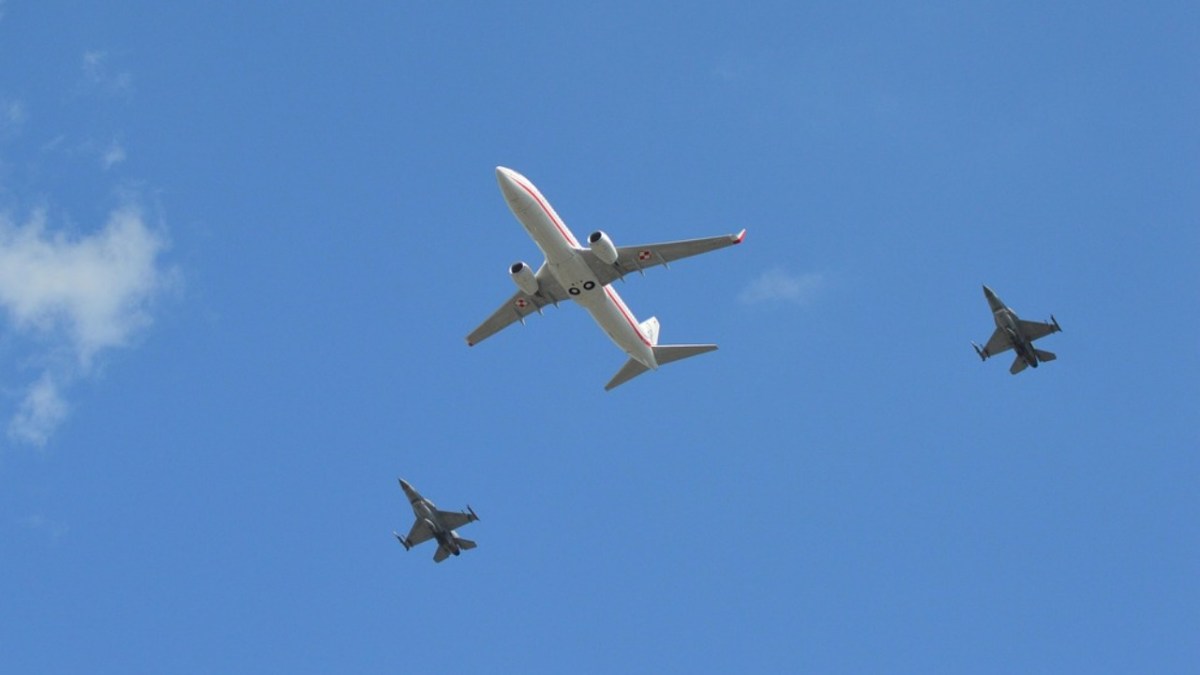

Ferry pilot Mattia Meneghello (@mattia_m14) was flying from the UAE to India when two military jets intercepted his plane, and he shared the encounter on Instagram. The video starts with footage from a camera mounted outside the cockpit, where Meneghello looked startled as a woman’s voice came over the radio.
She warned, “Unidentified aircraft in position 2305 north 06142, east at altitude 11,000, on course 097, speed 117, you approach a coalition warship operating in international waters. Establish communication. Identify yourself. Maintain 80nm from my station over.” Meneghello said in surprise, “That’s me.” The footage then cut to a jet flying alongside his plane to the right as he responded on the radio, “This is November 2007, Victor, on guard. I just saw traffic intercepting me off my right wing.”
A man then responded, “Yep, civilian traffic, you have two F-18s off your right wing orbiting. Just be advised you are approaching a coalition warship. Your current vector is trending away, so we’re just here to monitor.” He told Meneghello, “Just do not turn southbound,” and said the jets would keep a safe distance and monitor him for 40 miles. After Meneghello agreed to hold his course, the airman added, “Yeah, apologies, we weren’t trying to spook you, just monitoring.”
The jets were only there to keep an eye on him
In his caption, Meneghello explained that he had accidentally come too close to a US strike group, “whose location isn’t posted anywhere for obvious reasons.” He said the jets escorted him out of the area once the military was sure he was not a threat, the same kind of check fighter jets have run on small planes that strayed into restricted airspace.
He added, “I’ve heard of this happening to a couple of ferry pilots the last couple of months, but first time for me.” Many viewers commented on how tense the moment looked, with one writing, “Well two F18’s will absolutely get your attention real quick.”
Military ships at sea handle nearby traffic differently from civilian vessels. According to the National Law Review, military vessels generally keep a greater margin of safety when other craft approach, and nearby traffic should expect earlier and more frequent radio calls from them. Unlike commercial ships, they also often change course and speed during missions or training exercises.
The outlet also noted that some military vessels frequently conduct air operations, and aircraft carriers may move in a racetrack-style pattern while launching and landing jets. During air operations, military vessels display signals showing they are restricted in their ability to maneuver.
Attack of the Fanboy was unable to independently verify the military’s side of the encounter, as this account comes solely from Meneghello’s video.






Published: Nov 22, 2026 08:00 am