


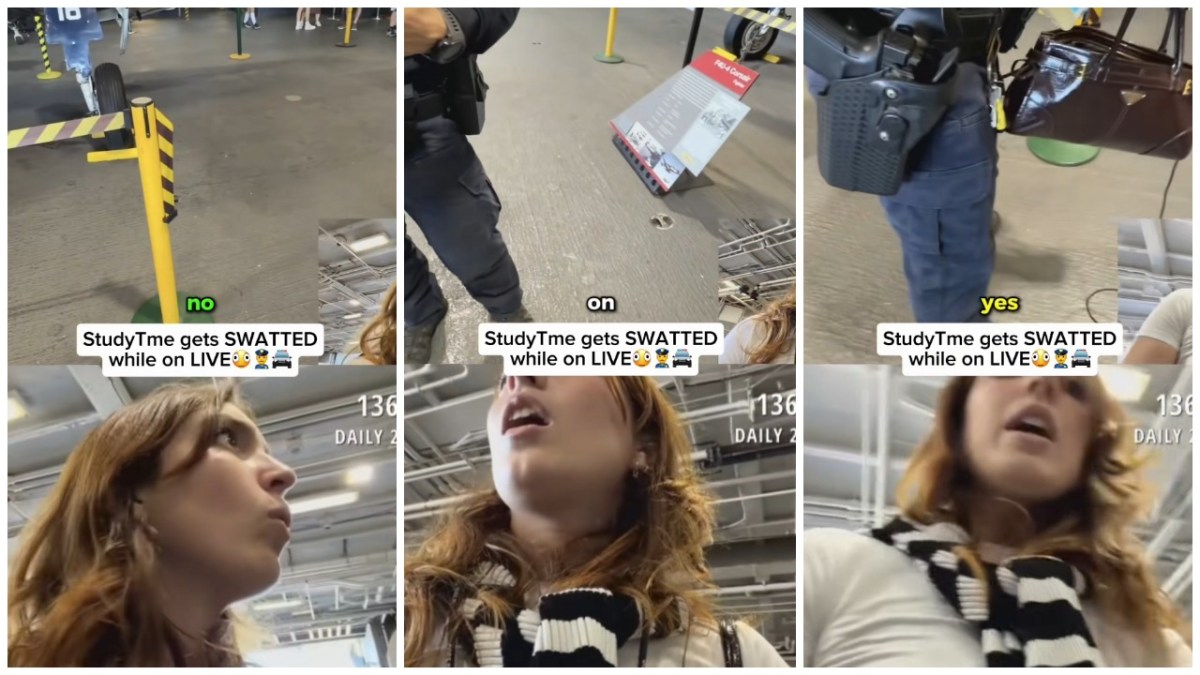

Giulia Mazza (studytme_), an Italian influencer visiting the United States, recently found herself in the middle of an encounter with what seemed like the police during a livestream on her first day in the country. While filming at an aircraft museum, she was approached by men who asked if she had called the police or possessed any weapons. Mazza, clearly caught off guard, told them, “No, I’m Italian, I don’t do weapons.”
Mazza’s Instagram and TikTok video garnered over three million views and is split-screen, with one side facing her, capturing her reactions, and the other facing away. In her video, she never asked for identification from the men, nor did the officials identify themselves verbally. The footage shows some parts of these men, dressed in navy blue and armed, one with a rifle. The situation is calm, with Mazza cooperating with the questions and handing over her ID.
Eventually, she asked if she had been swatted, identifying herself as a live streamer. The official explained, “The reason why we’re here today… Somebody called saying somebody got shot on the board and the two females matching your, you and your friend’s description. That’s why we’re here.” Mazza, visibly shaken, told her friend, “What a nice experience we’re getting.” She then consented to a bag search, and when the men thanked her for cooperating, she said, “Of course. It’s just scary for me.”
Swatting calls can have dangerous consequences
The term swatting, Cloudflare noted, involves generating an emergency law enforcement response against a target under false pretenses, like reporting a fake shooting, gun sighting, or hostage situation. While some perpetrators view this as a prank, it often leads to serious consequences, such as diverting police resources from genuine emergencies. In some instances, these encounters have resulted in injuries or deaths.
Although law enforcement agencies try to track down these callers, many use sophisticated techniques like caller ID spoofing to hide their identities. According to NPR, this is further complicated by a new trend of bad actors using AI-generated voices to make hoax calls sound more realistic.
NPR reported that experts from groups like APCO International say newer AI voices can mimic natural pauses and inflections, making it difficult for dispatchers to distinguish between a real emergency and a fake one. Dispatchers are now being trained to ask granular questions that an AI might struggle to answer, though they maintain that they must treat every call as a potential life-or-death situation.
Mazza’s video gained a lot of sympathy on her socials, and many people vented about the optics of the situation for the country. One user called it, “The real American experience,” while another wrote, “first day in the US and already getting asked if you’ve shot anyone. holy damn.” A third user noted, “This is scary ..why people are still going to usa anymore.”
Others discussed what kind of legal follow-up these calls might have. One user lamented, “The 911 system is so bad and outdated they usually can never even figure out who called. It’s absolute bullsh*t. Sadly more people will have to die before more people care.” Another wrote, “These people making false calls gotta be arrested,” with another wondering, “why can’t they arrest these callers? Just ignore the calls if they want to become anonymous.”
Attack of the Fanboy was unable to independently verify law enforcement’s side of the story, as this account originates solely from Mazza’s Instagram and TikTok posts.




Published: Nov 16, 2026 11:00 am