


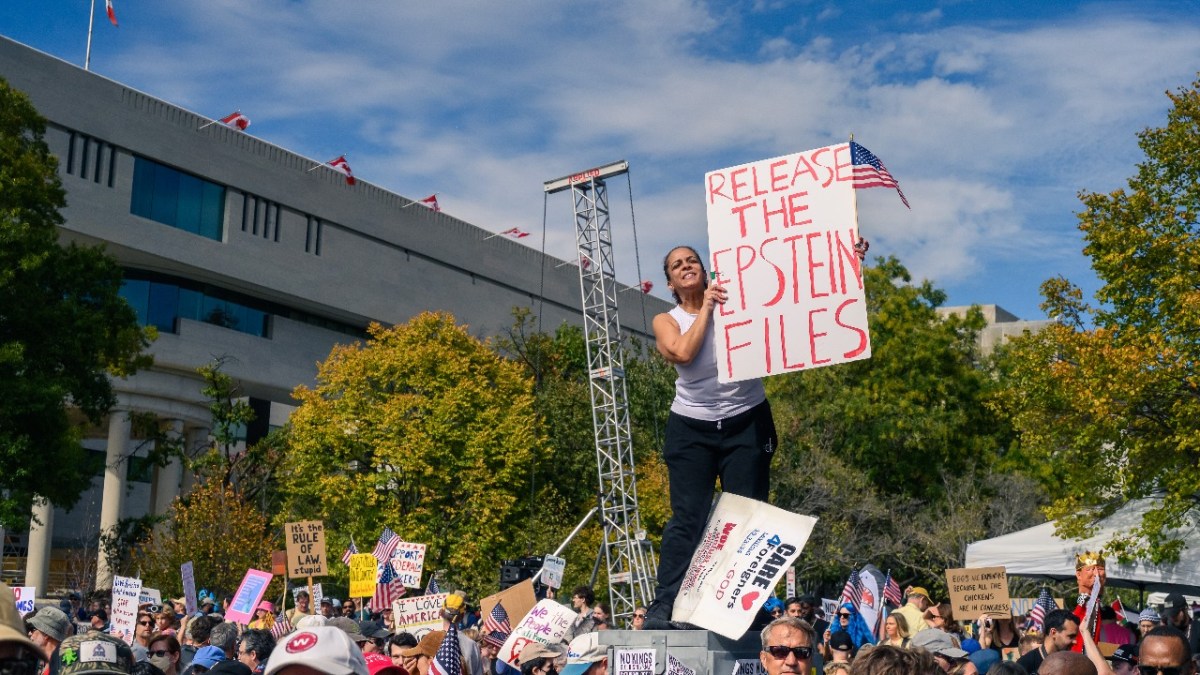

Attorney General Todd Blanche has long maintained that the Epstein files hold no secret information tied to national security, even in the portions kept from the public, according to CBS News. When the first releases began last winter, he pointed out that the Epstein Files Transparency Act permitted the withholding of material for national security or foreign policy reasons. At the time, Blanche said, “no files are being withheld or redacted on that basis.”
He went further while serving as deputy attorney general, stating, “There’s not some tranche of super-secret documents about Jeffrey Epstein that we’re withholding, we’re actually not withholding anything based upon [national defense information].” Yet at least three documents inside the large release show that classified material was part of what the Department of Justice collected.
The department has said it gathered 6 million pages and put out more than 3 million after checking for duplicates, attorney-client privilege, and relevance to Jeffrey Epstein. Challenges from Congress and an ongoing lawsuit are now questioning those claims and pressing for additional documents that were held back.
Delivery records and coding system point to classified items and large gaps
An eight-page timeline in the files tracks the FBI’s New York office as it located and sent its extensive Epstein materials to Justice Department headquarters in Washington. One entry from March 25, 2025, records the delivery of “16 Epstein items to ODAG,” the Office of the Deputy Attorney General. Two of those items are labeled “Epstein Transparency Project – Classified Material” and “CDs with classified materials (x2).”
The Epstein Transparency Project is the department’s internal review process for deciding what to redact, withhold, or release. Exactly what was marked classified is not spelled out. Each CD could hold hundreds of megabytes. Federal law allows classification only for national security reasons, but the specific content and the reason for classifying it remain unclear.
An email sent the same day comes from the unit chief of the National Security Classification Operations Unit, the office that reviews FBI records for classification or declassification. It carries an attachment titled “Epstein – Classified Document Memo.docx.” The message notes that three documents were “identified that remain classified.”
One is described as an “FBI document which is classified when see-through.” Descriptions of the other two are redacted, as is the name of the person who received the email. It is not certain the email and the delivery list refer to the same materials.
CBS News examined the numbering system the Department of Justice used to organize the files and found clues about documents that were not released. The codes do not describe the missing content, but they mark where gaps occur.
Each page in the Epstein files carries an EFTA number – short for Epstein Files Transparency Act – stamped in the lower right corner. These Bates numbers run from 1 to 2,858,498, roughly matching the pages released. The department has said earlier court records and investigative files push the overall total above 3 million.
Many pages also carry older Bates numbers from prior federal cases. Some come from the Ghislaine Maxwell criminal prosecution and were used to organize discovery materials for her defense team before the 2021 trial. Others trace to bank records from JPMorgan and Deutsche Bank gathered during the FBI’s trafficking investigation.
Gaps appear when the main EFTA number rises by one while the older Bates numbers jump by two or more. Those jumps suggest pages were removed after the department obtained the records.
Tens of thousands of such instances show up across the files. Among the missing material are pages from Epstein’s financial records that had been collected as evidence. In one stretch of roughly 4,500 check images from his accounts, 66 images are absent.
Sometimes only the front or the back is gone; in other cases both sides are missing. Comparing the sequences against the final EFTA totals indicates tens of thousands of pages are absent from these sections, with no stated reason.
Barbara McQuade, former U.S. Attorney for the Eastern District of Michigan, told CBS News, “Financial records were not a permissible category for removal.”
She noted, “It’s the reason you have Bates numbers, so you notice something like that.” The Department of Justice has not answered CBS News’ recent questions about the files. It has previously said that every document the Epstein Files Transparency Act required to be released has been released, and that the rest were unrelated, privileged, or duplicative.
A separate set of Bates numbers appears to come from an earlier stage of processing. Many of these carry an “R1” marker between the EFTA prefix and the page number. This R1 sequence covers about 995,000 released pages.
The EFTA numbers stay in order, but the R1 numbers contain gaps ranging from a single page to hundreds of pages. Each gap signals that material was removed. The documents involved are mostly emails, and none of the examined files show partial messages, so entire exchanges appear to have been taken out.
The difference between the earliest and latest numbers in this earlier sequence versus the final release adds up to 1.2 million pages of gaps in this section alone.
Most of the emails in that portion are to or from Jeffrey Epstein. They include messages with young women who later accused him of abuse, exchanges with business associates, notes to or from his assistant Lesley Groff, and communications involving Ghislaine Maxwell.
One possible reason for many of the email gaps is an instruction given to department attorneys handling redactions: “If the document is an email chain and the most-inclusive email (i.e., containing all the back-and-forth) has already been reviewed and redacted as appropriate for production, the interstitial back-and-forth can be marked as duplicates.”
That approach would treat earlier messages in a chain as duplicates of the final one. Duplicate emails still appear throughout the released files, so the step was only partly carried out.
Independent journalist Katie Phang has sued the Justice Department for more files and for an explanation of the redactions and removals. A federal judge has ruled in her favor several times, and the department is appealing. She is also asking the court to appoint a special master to examine the materials.
Phang told CBS News, “If it wasn’t intentional, then was it gross negligence? Were you just lazy? If it was intentional then I think there’s [expletive] there that they don’t want people to see.” She continued, “My speculation runs an entire spectrum of reaction — but at the end of the day it just makes the DOJ look bad.”
The department has admitted several mistakes. It removed and later restored a photo of Commerce Secretary Howard Lutnick from a 2012 visit to Epstein’s island. The DOJ also pulled thousands of files over redaction errors that risked exposing victims.
Officials also claimed last year that a minute of prison security video from the night Epstein died was missing, a statement that turned out to be incorrect. Attorney Stanley Brand told CBS News, “This is a case where the process has inhibited public trust in what is ultimately released, and there’s a long tradition of this, whether it’s the Pentagon Papers or the Epstein files.”
He added, “This is just another piece where the government process, where making this stuff available just fuels suspicion that there’s something we’re not seeing, and I don’t know that ever gets resolved.”








Published: Oct 29, 2026 10:15 am