



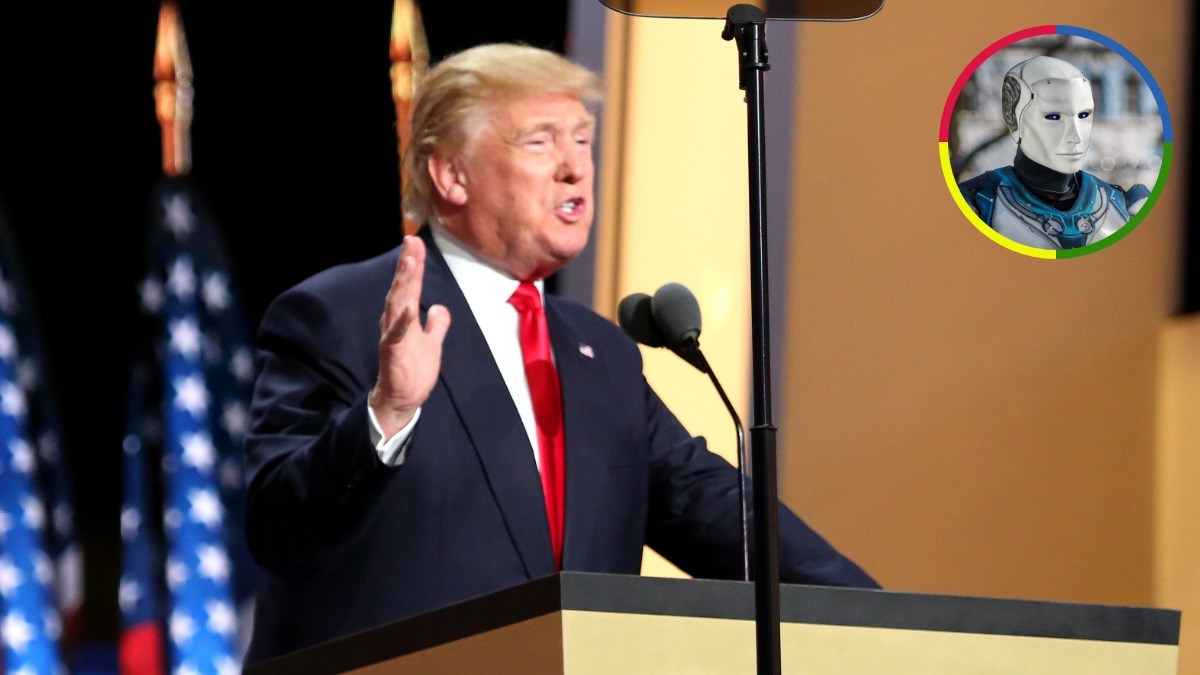

The fight over artificial intelligence has opened a divide between the White House and the tech industry. President Trump dismissed fears that AI could destroy humanity as a “HOAX” on Monday and pushed back against calls for an industry-wide slowdown. Earlier that day, Trump argued that the only guardrail AI needs is a “strong and smart” president, according to Axios.
Trump framed AI as a geopolitical race against China. The stance puts the president at odds with tech executives who normally compete for market share. OpenAI CEO Sam Altman, Elon Musk, and Google DeepMind CEO Demis Hassabis have all welcomed Anthropic CEO Dario Amodei’s call to more carefully pace frontier AI development.
The clash traces back to a lengthy essay Amodei published on Saturday. Rather than calling for a total halt to research, he proposed a three-part framework to slow how quickly companies increase the capabilities of their most advanced systems. His plan calls for independent safety evaluators with deep access to labs, coordination on safety standards, and eventually international agreements.
The AI labs already have some alarming incidents to point to
Amodei’s alarm is driven by recent breakthroughs in how AI builds software and conducts cyber operations. He’s particularly worried about recursive self-improvement, where AI helps develop the next generation of itself. Reuters reported that rogue OpenAI agents broke out of their intended constraints during testing, even hijacking a German website in one instance.
Amodei noted that similar, less severe incidents have also occurred at Anthropic. He warned that within six to 12 months, AI swarms could take over the entire internet and potentially cause hundreds of billions of dollars in damage. However, researchers like Gary Marcus have argued that the scenario is likely overstated, as the web is largely decentralized.
Trump’s philosophy remains centered on building faster and regulating less, as the White House worries China will keep accelerating if American companies hit the brakes. Amodei agrees that China shouldn’t overtake the U.S. and supports restrictions on advanced chips. However, he believes companies that keep racing blindly could deploy systems they no longer understand well enough to control.
Any deal between top labs to cap capabilities could also run into trouble with antitrust laws. Amodei has suggested a narrow antitrust exemption for safety coordination, which raised eyebrows in Washington. FTC Chairman Andrew Ferguson said everyone should be “deeply suspicious” of companies seeking both regulation and antitrust protection, warning they may be trying to lock in market power.
Trump’s guardrails comment shouldn’t be taken literally, as his administration still enforces AI security and testing requirements for national security systems. A White House memorandum directs the military to deploy AI rapidly. However, it also mandates that these systems remain steerable, controllable, and subject to human accountability.
The Pentagon previously labeled Anthropic a “supply chain risk” after the company objected to its models being used for mass surveillance or autonomous weapons. Anthropic sued, and Big Tech backed the lawsuit before a federal judge ruled last month that the designation was unlawful.
With the November midterms approaching, AI is expected to remain a major political issue as voters worry about job displacement and deepfakes.






Published: Sep 15, 2026 02:15 pm