



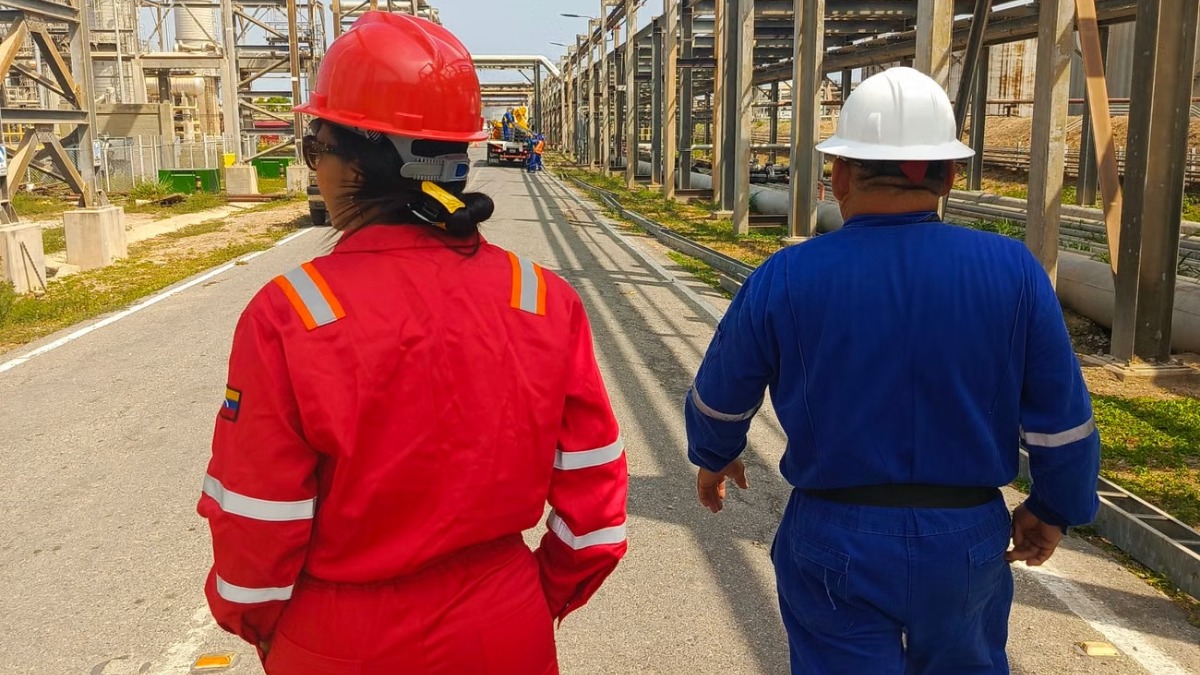

Nearly eight months after President Trump said American companies would help rebuild Venezuela’s oil industry, no new oil deals have been finalized with U.S. firms. A dozen oil industry professionals, senior U.S. officials, and people close to the Venezuela situation told Axios that the Department of Energy is largely responsible for the delay.
The lack of finalized deals is drawing more attention now because oil prices are rising as the Iran war limits the global oil supply. Venezuela holds the largest estimated oil reserves in the world.
“We have no new concessions. No new deals. It is absolutely a problem,” a senior U.S. official said. “The Energy Department is in charge of this and they have some explaining to do.” The Energy Department and people who support its approach say these criticisms are unfair and that new oil deals will be signed in the coming weeks.
A divided approach inside the Trump administration slowed the process
Rebuilding Venezuela’s oil industry is difficult because of years of mismanagement and nationalization under former leaders Hugo Chavez and Nicolas Maduro. Maduro was removed from power by U.S. forces on January 3.
Six days later, Trump met with oil industry leaders and said the U.S. would decide which companies could help “rapidly” rebuild Venezuela’s oil sector. “You’re dealing with us directly,” Trump said at the time. “You’re not dealing with Venezuela at all. We don’t want you to deal with Venezuela.”
Trump’s plan ran into two divides. One was inside his own administration. The other was inside the oil industry itself. Large global companies, known as “majors,” like Exxon and ConocoPhillips, move slowly and carefully, and they publicly showed little interest in returning to Venezuela because of the uncertainty there. Smaller, independent companies, known as “wildcatters,” were known for moving faster and taking on more risk, and many of them wanted in.
Within the Trump administration, MAGA-aligned officials wanted Washington to follow through quickly on Trump’s January 9 comments and push Venezuela’s state oil company, PDVSA, to adopt standard international contracting practices. Officials at the Energy Department, who have less international oil industry experience, pushed for a slower process that worked more closely with the government in Caracas.
Secretary of State Marco Rubio has also played a significant role in Venezuela policy, and reporting has detailed his influence over Venezuela’s finances. Two earthquakes on June 28 caused significant damage in Venezuela, adding a new complication, and discontent in the country has been rising.
Mauricio Claver-Carone, Trump’s former top adviser on Venezuela, said the Energy Department favored major oil companies over wildcatters. “Starting January 4th, it should have been carte blanche for all American producers to take risk. That’s America First,” Claver-Carone told Axios. “Instead, American wildcatters got stuck with onerous conditions and a competitive disadvantage versus the mostly foreign majors that were in bed with Maduro.”
Over time, more wildcatters aligned themselves with MAGA officials and with the White House’s National Energy Dominance Council (NEDC), and tensions grew with the more cautious officials at the Energy Department. “NEDC was there early advocating for the wildcatters. But Energy is really turf-obsessed. And Energy won. The problem now is that they own this,” an oil industry insider said.
In recent weeks, State Department officials have urged Venezuela’s acting president, Delcy Rodriguez, to sign more contracts with wildcatters. These efforts could lead to deals being finalized by the end of the month. One industry official said some of the deals close to being finalized could involve newly formed companies that have no track record, no financial history, and possible ties to China or corrupt insiders in Caracas.
Energy Department officials say they have supported legitimate U.S. wildcatters and have worked to improve Venezuela’s hydrocarbon law to give American companies more access. “The Energy Department continues to work with Venezuelan officials and American energy companies of all sizes to unleash Venezuela’s resource potential, and we are delivering,” department spokesperson Ben Dietderich said. He added that oil production and exports are up to levels “few thought possible.”
Alex Cranberg, a wildcatter with Colorado-based Aspect Energy, said officials in Caracas are “drinking from a fire hose” as they try to manage demand while keeping out scammers. Bill Armstrong, owner of Texas-based Armstrong Oil & Gas, said Energy Department and PDVSA officials are “working hard behind the scenes” to reorganize the industry.
Two independent oil companies shared documents with Axios showing that they had asked the Energy Department for months to require PDVSA to recognize standard international contracts for high-risk drilling projects, but said not enough action was taken. “We’re months behind. We’d be lifting oil now if we got half the deference the majors got,” one wildcatter said.
A representative from another oil firm said, “The problem isn’t that Energy is doing too much in Venezuela, it’s that they’re doing it for the wrong customers. Put the wildcatters in the fields and production shoots up straight away.” Trump’s broader approach to Venezuela has also drawn comparisons to his handling of other foreign conflicts, including his shifting attitude toward the Iran war.
For weeks, White House officials have heard complaints from the industry, along with requests that Rubio take over this issue from Energy Secretary Chris Wright. Rubio has left the matter to the Energy Department, partly because many companies want the government to choose which firms succeed and which do not. Major oil companies are also competing with each other to redevelop some of the same oil fields, according to the Wall Street Journal.
Venezuela currently produces about 1.2 million barrels of oil a day, slightly more than the 1.1 million barrels it produced daily before Trump imposed a blockade-like quarantine in November and Maduro was removed from power at the start of the year.
Venezuela’s oil production peaked at about 3.4 million barrels a day in 1998, the year before Chavez took office and the industry began to decline. Estimates vary on how much production might have increased if regulations had eased starting January 4, ranging from a few hundred barrels a day to hundreds of thousands.
White House spokesperson Taylor Rogers said the Energy Department “is ushering in unprecedented investment in Venezuela to restore its energy infrastructure.” She added that the department “continues to facilitate productive conversations between oil companies and the Venezuelan government to unleash its abundant resources, which benefits both the American and Venezuelan people.”






Published: Aug 4, 2026 01:45 pm