



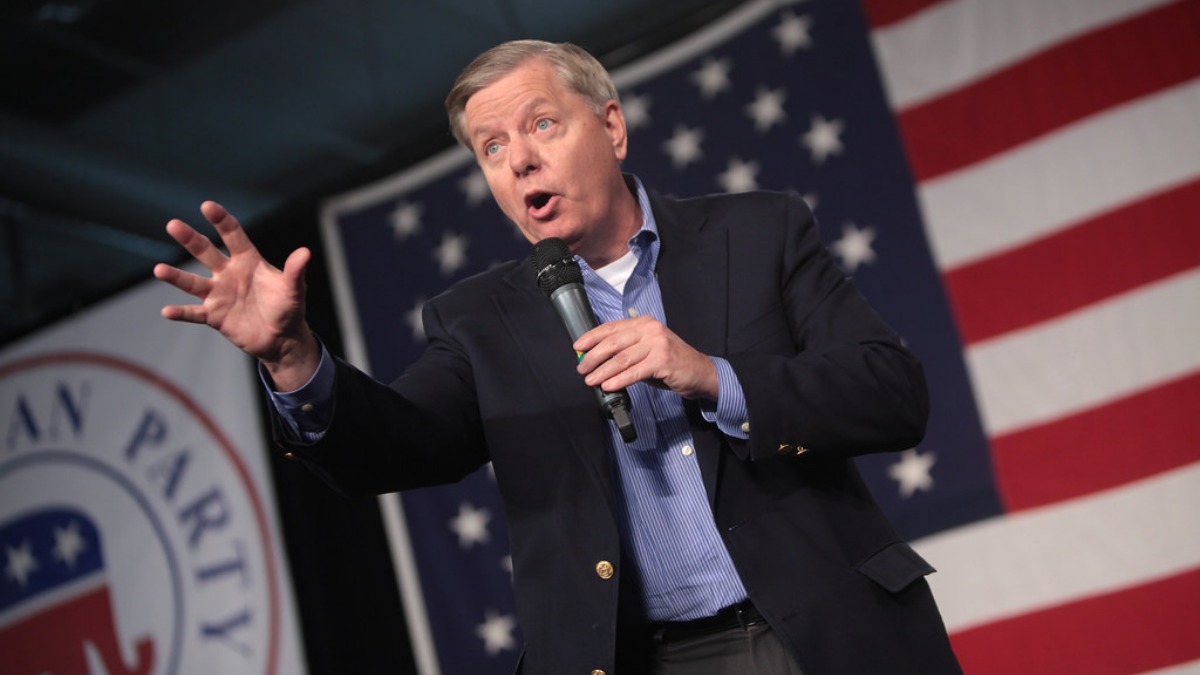

Senator Lindsey Graham is making it clear that he holds significant skepticism regarding the tentative deal currently in place between the United States and Iran. During a recent appearance on Face the Nation, the South Carolina Republican told host Margaret Brennan that he believes the agreement is ultimately headed for failure. He noted that the diplomatic path is worth exploring, but his expectations for a positive outcome remain quite low, The Hill reported.
This diplomatic effort centers on a memorandum of understanding, or MOU, which was signed by both nations. The agreement provides a 60-day timeframe for the two countries to reach a final consensus regarding Iran’s nuclear program. It also immediately waives various U.S. sanctions on Iranian crude oil, petroleum products, and associated services.
However, the situation on the ground remains volatile, especially with renewed fighting between Israel and Hezbollah in Lebanon. This conflict has already caused delays, as the talks in Switzerland, originally scheduled for Friday, did not kick off until Sunday.
Graham did not shy away from predicting what might happen if the current diplomatic route falls apart
Graham stated, “If you don’t have a diplomatic path through the MOU, then you have to go to war, or some other form of coercion.” The senator suggested that if the deal fails, President Trump will likely take matters into his own hands by forcibly taking over the Strait of Hormuz and charging a fee for passage. This echoes sentiments expressed by the President himself. Trump recently told reporters that he may take over the Strait if the U.S. and Iran fail to make a deal, even adding, “I’ll blow the s— out of them.”
The geopolitical stakes are incredibly high, as the Strait of Hormuz is a critical waterway for the global energy market, with roughly a quarter of the world’s oil traveling through it. While Iranian officials have signaled they might close the strait in response to Israeli strikes in Lebanon, Energy Secretary Chris Wright reported that 67 ships successfully traveled through the area on Sunday. Another 55 vessels passed through a southern route on Friday, aided by U.S. military escorts.
Vice President Vance, who is currently in Switzerland for the nuclear talks, praised the record-breaking flow of oil through the channel on Saturday, noting that there was no evidence of Iran shutting down the strait.
There is also a complicated financial component to these discussions. One of the 14 points of the MOU explicitly mentions that the United States will work with regional partners to develop a plan for at least $300 billion in reconstruction and economic development for Iran.
Graham previously compared this to the Marshall Plan for post-World War II Germany, but he has since adjusted his stance. He explained to Brennan, “Because before I thought the money was coming from the West.” He now views the potential for investment from countries like Saudi Arabia, Qatar, and the United Arab Emirates differently, suggesting that such an influx of capital would indicate a genuine change in Iran. Even so, he remains doubtful that $300 billion would be enough to fully facilitate reconstruction or turn Iran and Gulf states into stable business partners.
President Trump has sought to distance his administration from this specific fund. He dismissed reports about the $300 billion investment as fake news and emphasized that the United States will have no direct involvement in it. During the G7 summit in Évian-les-Bains, France, on Wednesday, the President told reporters that while others may choose to invest, the U.S. has not requested that Gulf countries provide this funding.
Despite the complexities, the administration continues to press for a resolution. On Sunday, Vice President Vance met with Pakistani Prime Minister Shehbaz Sharif and Pakistan Army Chief Field Marshal Asim Munir near Lucerne, Switzerland, alongside special envoy Steve Witkoff and Jared Kushner. Pakistan is currently acting as a key mediator in the ongoing Middle Eastern conflict. Vance remains optimistic about the broader process, telling reporters on Sunday that he feels great about the progress in Lebanon, even though there is still additional work to be done.
President Trump has maintained a firm posture throughout these negotiations. On Sunday, he posted on Truth Social that Iran must stop their proxies in Lebanon from causing trouble. He warned that if they do not comply, the U.S. will hit Iran again, even harder than before.
The senator from South Carolina agrees with this firm approach, suggesting that the new policy will be a direct retaliation against Iran whenever Hezbollah attacks Israel. It is clear that while the diplomatic door is open, the margin for error is razor-thin, and the threat of military force is never far from the conversation.









Published: Jun 21, 2026 04:30 pm